
Parcl: One Digital Square Foot at a Time.


Real estate stands as the largest asset class in the world, providing a rare investment vehicle that offers multiple advantages, including but not limited to potential appreciation, leverage, and even tax benefits.
However, it is important to acknowledge that the realm of real estate investment is not without its fair share of challenges. One significant hurdle has to do with the substantial upfront capital required to participate.
Additionally, the presence of institutional purchasing and the increasing popularity of iBuying add further structural complexities to the market.
An iBuyer is a company or platform that uses technology and data analysis to quickly assess and make cash offers on homes. They aim to simplify the home selling process by providing a fast and convenient way for homeowners to sell their properties without the traditional hassles of listing with a real estate agent.
These barriers to entry and various others that we will discuss are now being effectively mitigated by the wonder that is Parcl.
What is Parcl?
Parcl is a blockchain based protocol built on Solana that allows you to invest in the digital square foot of physical real estate in both cities and neighbourhoods around the world.
The valuation of each synthetic parcel is tied to an index that is representative of real life properties, and it's platform provides a live feed of every neighbours square foot price.
It bridges the established investment class that is real estate with cutting-edge blockchain technology to provide data-driven solutions for the modern investor.
Parcl has a focus of disrupting the exclusivity hurdle many millennials face, and not only does it grant everyday individuals residing within the United States access to the most sought-after neighbourhoods throughout the country, but it also presents an opportunity for individuals from diverse countries all around the globe, who more than likely would not have had the chance otherwise, to invest in the world's largest real estate market irrespective of their geographical location.
Parcl has introduced an innovative solution that enables individuals to gain exposure to the value of residential real estate.
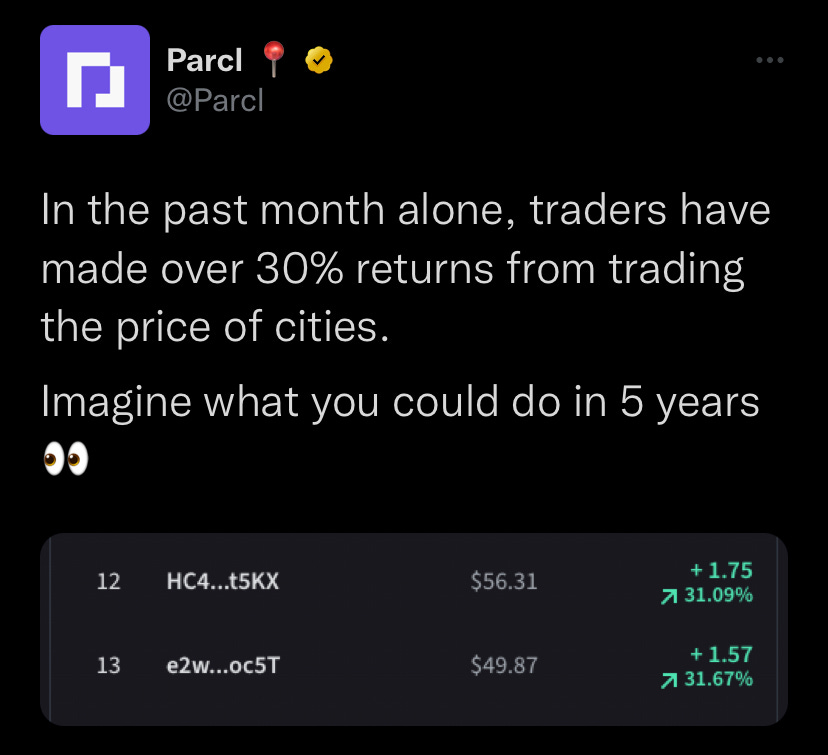
With a unique position to address the inherent deficiencies in the market, it is poised to revolutionise the traditional norms of real estate and fundamentally alter the global perception of real estate investing.
Parcel’s intention is not to replace traditional real estate investing but to make it more accessible to a much wider audience.
Parcl allows current real investors to access and hedge investments in real time, they also provide access to people who normally cannot afford to invest in real estate in america by reducing the barriers to entry which includes removing the regulatory process to ownership by utilizing synthetic assets.
According to Parcl, the ultimate mission is to bring real estate to everyone.
How does Parcl work?
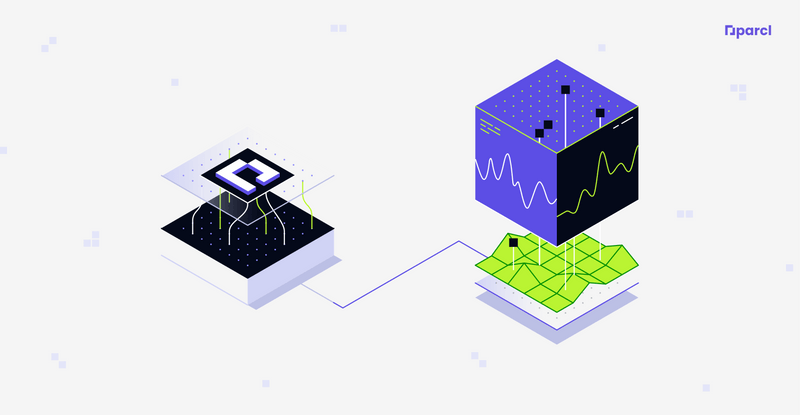
Parcl v2 is a noncustodial automated market maker (AMM) that focuses on providing liquid trading markets for perpetual synthetic assets.
Perpetual synthetic assets may sound complicated, so let's break it down in a simpler way.
Imagine you have a special card that represents something valuable, like a collectible or membership. This card is not the actual collectible or membership, but it represents them.
Now, what if you want to trade this special card with your friend for something else? You both agree that the card is worth a certain value, and you want to exchange it for something of equal value.
Perpetual synthetic assets work in a similar way. They are like these special cards, but instead of representing collectibles, they represent other things, like cryptocurrencies or stocks.
Perpetual synthetic assets are designed to represent these statistical computations or calculations of values that don't have traditional markets available. In this case, the aggregate of real estate prices, which means adding up the prices of all the houses in a specific area.
Instead of buying and selling actual houses to track these prices, people can use synthetic assets that represent the statistical computation of the aggregate real estate prices. These synthetic assets give them a way to participate in the movements of these values without directly buying or selling real houses.
The architecture of Parcl is designed to offer several key features:
Solvency
Parcl ensures solvency by maintaining a reserve of funds to back the value of the synthetic assets. This reserve is used to provide liquidity and ensure that the assets can be redeemed at their target value.
Each Parcl pool has a collateral stable coin and single price feed, both of which are set at the time of the pool’s creation. Also known as liquidity token, these tokens represent ownership and participation in the pool. When traders enter a position (start a trade), they receive these liquidity tokens.
The liquidity tokens serve a dual purpose. Firstly, they indicate ownership in the pool. So when traders have liquidity tokens, it means they have a stake in the pool and its assets. Secondly, these tokens are used for tracking profits and losses (PnL) of positions. It helps keep a record of how well a trade is doing.
The exchange rate for adding or removing liquidity from the pool is determined by the ratio of the total collateral (all the assets in the pool) to the total number of liquidity tokens that are in circulation. This exchange rate helps maintain the balance between the value of the assets and the liquidity tokens in the pool.
All closed positions are paid out in liquidity tokens, which means that all traders become implicit (Liquidity Providers)LPs at position open and become explicit LPs at position close. This is the mechanism that forces solvency because traders are not paid out dollar for dollar in collateral.

During a close position transaction, the protocol mints or burns liquidity tokens in direct proportion to the position’s profit or loss at the current liquidity token exchange rate.
Zero Credit Risk
Unlike traditional financial systems, Parcl eliminates credit risk. Since there is no borrowing or margin account concept, there is no credit risk. The pool is compensated for trader risk, with or without leverage, in long-short funding among other mechanisms.
Imagine you have a place where you can trade assets. Normally, when you want to trade, you need to have the full amount of the thing you want to trade. But in this place, you can borrow some extra of that thing to trade even if you don't have all of it. This is called borrowing on margin.
However, on Parcl, they don't allow you to borrow on margin. Instead, they let you choose something called leverage. Leverage is like a tool that makes your trades have a bigger impact. It's like using a magnifying glass to make something bigger.
But because using leverage can be risky, parcl wants to make sure they are compensated for taking on that risk. They do this in two ways: long-short funding and skew impact fees.
Long-short funding means that when people use leverage, they have to pay some money to the pool to make up for the extra risk they are taking. It's like paying rent for using something.
Skew impact fees are another way Parcl gets compensated for the risk. When people use leverage, it can affect the balance of the pool and create something called skew. To fix this skew, Parcl charges some fees to make sure the pool stays balanced.
So basically, you can't borrow things to trade on Parcl, but you can use leverage to make your trades bigger. And to make sure they are protected from the extra risk, Parcl charges fees and gets compensated for it.
Parcl also uses smart contracts to establish predefined rules and conditions that all participants must adhere to when engaging in asset trading and settlement. These rules are transparent, immutable, and automatically enforced by the blockchain, leaving no room for interpretation or manipulation.
Capital Efficiency
Parcl aims to optimize capital efficiency by enabling participants to trade synthetic assets with minimal capital requirements. The automated market maker mechanism allows users to trade assets without relying on traditional order book liquidity, which can often require significant capital to provide.
In a traditional trading setup, buyers and sellers rely on order books to match their trades. Order books require participants to place buy or sell orders at specific prices, and trades can only occur when these orders match. This model often requires significant capital from market makers who provide liquidity by placing orders on both sides of the market.
Parcl's AMM mechanism operates differently. Instead of relying on order books, it utilizes smart contracts to algorithmically determine asset prices and execute trades. These smart contracts pool assets and liquidity from participants, and the prices are determined based on a mathematical formula
This approach offers several benefits:
Minimal Capital Requirements: Since Parcl doesn't rely on traditional order book liquidity, participants can trade synthetic assets without the need for significant capital. This reduces barriers to entry and allows a broader range of users to participate in trading.
Continuous Liquidity: The AMM mechanism ensures continuous liquidity for trading synthetic assets. As long as there are participants willing to provide liquidity, users can buy or sell assets at any time without waiting for matching orders.
No Dependency on Market Makers: Parcl's AMM eliminates the reliance on market makers to provide liquidity. This decentralizes the trading process and removes the need for intermediaries, resulting in a more efficient and transparent trading environment.
Price Efficiency: The AMM mechanism automatically adjusts asset prices based on supply and demand. This ensures that prices are updated in real-time and reflect the market conditions accurately.
Lower Slippage: Compared to traditional order book models, AMMs generally experience lower slippage when executing trades. Slippage refers to the difference between the expected and actual execution prices, and lower slippage means users can obtain assets at more favorable prices.
By leveraging an AMM mechanism, Parcl optimizes capital efficiency and provides users with an accessible and efficient trading experience for synthetic assets.
Price Execution at Oracle Prices
Parcl relies on oracles, which are trusted data sources, to provide the necessary price information for the synthetic assets. The oracles supply real-time data related to the statistically computed values, such as aggregate real estate prices or macroeconomic measures. Parcl ensures that the execution of trades and asset pricing aligns with the prices provided by these oracles.
The protocol's configuration allows for integration with various oracle providers supported by the blockchain on which the smart contract instance operates. The protocol is compatible with Pyth oracles. To ensure data accuracy, the protocol rejects Pyth prices that are more than approximately 2 minutes old or have a reported confidence more than 5% of the exponential moving average price.
By combining these features, Parcl aims to create a robust and efficient trading environment for perpetual synthetic assets that may not have liquid markets otherwise. The system provides solvency, eliminates credit risk, optimizes capital efficiency, and ensures accurate price execution through the use of oracles
Parcl features
Parcel features a combination of;
AMM pools to provide liquidity at all times and all prices
Multiple markets via pools
Fast real time asset price aggregation
Ability to invest as small as $1
Pool management can be configured to be permissionless, liquidity provision is permissionless
Parcl price feed which is crucial in that the value of the investment on the parcl increases if the parcl labs price feed for the area in which you are investing increases.
Parcl labs API for quants or automated trading, for interacting with historical active and listing on parcl
What are the benefits of investing in real estate?
Real estate investments present new opportunities for crypto natives by bringing such a stable asset class on chain. They can now access the benefits that come with this class of real world assets, here we're going to cite a number of benefits for crypto natives specifically:
Portfolio Diversification
Diversification is a crucial aspect of investment strategy, especially for crypto natives who are well aware of the high volatility and rapid fluctuations in cryptocurrency values. Investing in real estate offers a valuable opportunity for diversification by introducing a tangible, real-world asset to an otherwise predominantly digital portfolio.
By incorporating real estate investments, individuals can mitigate the risks associated with the volatile nature of cryptocurrencies and potentially reduce their overall investment risk.
Opportunity for Leveraged Investments
Real estate investments often allow for leverage through mortgages or loans. Let's say an investor wants to purchase a property worth $800,000, and they have $500,000 in cryptocurrencies. By utilizing leverage, they can secure a mortgage for the remaining $300,000. If the property appreciates by 5%, the investor's return on investment (ROI) would be calculated based on the total property value, not just their initial investment of $500,000. This means that the ROI would be higher compared to investing solely with their own fund.
Crypto natives, with their accumulated wealth in cryptocurrencies, have a unique advantage when it comes to leveraging their assets for real estate investments. By utilizing their crypto holdings as collateral, they can access favourable financing options to fund property purchases. This strategic approach not only amplifies their investment potential but also allows them to diversify their portfolio, increase their exposure to the real estate market, and potentially achieve higher returns through the combination of crypto and real estate assets.
Stable Cash Flow
Real estate investments, such as rental properties or commercial buildings, can generate regular rental income. Based on information from a report by Attom Data Solutions, the average gross rental yield for single-family homes across the United States was approximately 7.7% in 2020.
This indicates the potential income that can be generated through rental properties, and this income can serve as a consistent cash flow stream that is separate from the crypto market. It can provide a stable source of income to cover expenses, reinvest in cryptocurrencies, or diversify into other assets.
Safeguard Against Inflation
Over the past few decades, the average annual inflation rate in the United States has hovered around 2-3%. This means that the purchasing power of a dollar diminishes by that amount each year, but real estate investments can serve as a sort of inflation hedge. Unlike fiat currencies that lose value over time due to inflation, real estate properties have demonstrated a historical tendency to retain or even appreciate in value.
According to data from the U.S. Bureau of Labor Statistics, between 2000 and 2020, the cumulative inflation rate in the U.S. was approximately 50.9%. During the same period, residential real estate prices increased by an average of 4.2% per year. This quality of real estate allows investors to protect their wealth from it's erosive effects and maintain their purchasing power in the long run.
Tax Benefits
By engaging in real estate, individuals can deduct expenses such as property taxes, mortgage interest, and depreciation costs. These deductions serve to minimize their overall tax liability, providing a valuable opportunity for tax optimization and increased financial gains.
Additionally, one of the most significant tax benefits for real estate investors is the concept of a 1031 exchange (also known as a like-kind exchange). Under this provision, if an investor sells a property and reinvests the proceeds into another property of equal or greater value within a specific timeframe, they can defer paying capital gains tax on the sale. This allows investors to preserve their capital and potentially grow their wealth further by reinvesting in a more lucrative property.
Real Estate Indices VS Fractional Ownership
Investing in either real estate indices or fractional ownership would be beneficial regardless of which venture is chosen, and the choice between the two is dependent on ones investment goals, risk capacity, and preferences. Below we state and expand on some potential benefits of each:
Benefits of Investing in Real Estate Indices
Liquidity
Real estate indices offer greater liquidity than direct property ownership. ETFs (exchange-traded funds) or mutual funds are available to trade index shares easily, allowing for flexibility in managing your markets.
Diversification
By providing access to a broad portfolio of properties, real estate indices aid in reducing risk by spreading it across different locations, sectors, and types of real estate assets. This helps mitigate the impact of localized market declines.
Lower Entry Barriers
Real estate indices make real estate more accessible to a more diverse, wide range of people because they require relatively less capital to invest. Instead of buying up the entirety of a property, you buy part of it using an index.
Professional management
Real estate indices are typically managed by professional fund managers with expertise in analyzing and selecting properties. As a result, the investor doesn't have to deal with the process of property selection, acquisition and the on going maintenance responsibilities
Benefits of Investing in Real Estate Fractional Ownership
Direct Ownership
Investing in fractional ownership gives you more control over your investment descions, such as selecting properties, renovating them and managing rentals. It also allows you to reap the benefits of any capital appreciation that may occur
Higher Potential Returns
In addition to real estate indices offering diversified portfolio, fractional ownership may offer higher returns if you select the right property, renovate it, and actively maintain it. Succeeding in these tasks can help improve the rental income and property value
Tangible Asset
Owning a fractional share of a property provides the satisfaction of having a tangible asset. Some investors prefer the physical nature of real estate ownership and the ability to visit and see their investment firsthand.
Tax Benefits
Fractional ownership may provide certain tax advantages, such as the ability to deduct property-related expenses and depreciation, which can help reduce your tax liability.
Ultimately, the decision to investing in either real estate indices or fractional ownership rests on your investment goals, risk capacity, available capital, and preference for direct ownership versus passive investment. any investment decisions.
The Competition
While the market is crowded with competitors on Ethereum, this groundbreaking product on Solana enjoys a unique position as it faces no direct competition within its realm. The absence of rivals speaks volumes about its unparalleled capabilities and untapped potential.
The closest thing we have to a competitor in Solana would be Blосіtіеѕ, which is a platform that allows users to еаѕіlу сrеаtе and trade property titles digitally using NFTs on solana.
While over on ethereum we have Propy. It is an end-to-end real estate transaction management platform, a real estate listing platform, and a decentralised registry, that when using in combination, serves to eliminate fraud and facilitate considerably fast transactions.
We also have Deedcoin, which is a platform that hones in on blockchain technology and smart contracts to provide a more efficient and cost-effective way to buy or sell real estate. The main concept behind Deedcoin is to enable home buyers and sellers to connect directly with qualified real estate agents while minimising traditional agent commissions. Deedcoin offers a decentralised marketplace where users can purchase tokens (called Deedcoin) to access discounted real estate services.
A couple of other notable platforms include RealT, Ubitquity and Harbor.
How to trade on Parcl
The first step to trading on Parcl is funding you wallet with a at least $1.
Next you have connect that wallet on app.parcl.co
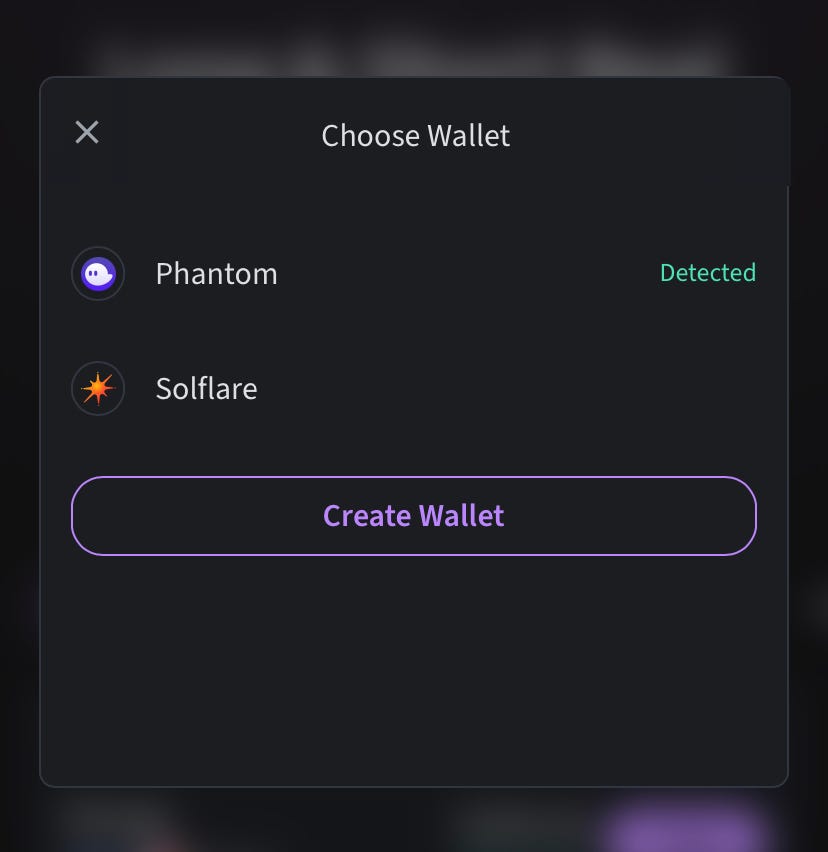
Then you have to analyze using a few beginner parameters.
Open interest which is a measure of the flow of money into that market,
TVL which measures the total USDC in the pool,
Market sentiment which indicates what percentage of the pool is either shorting or longing the market and
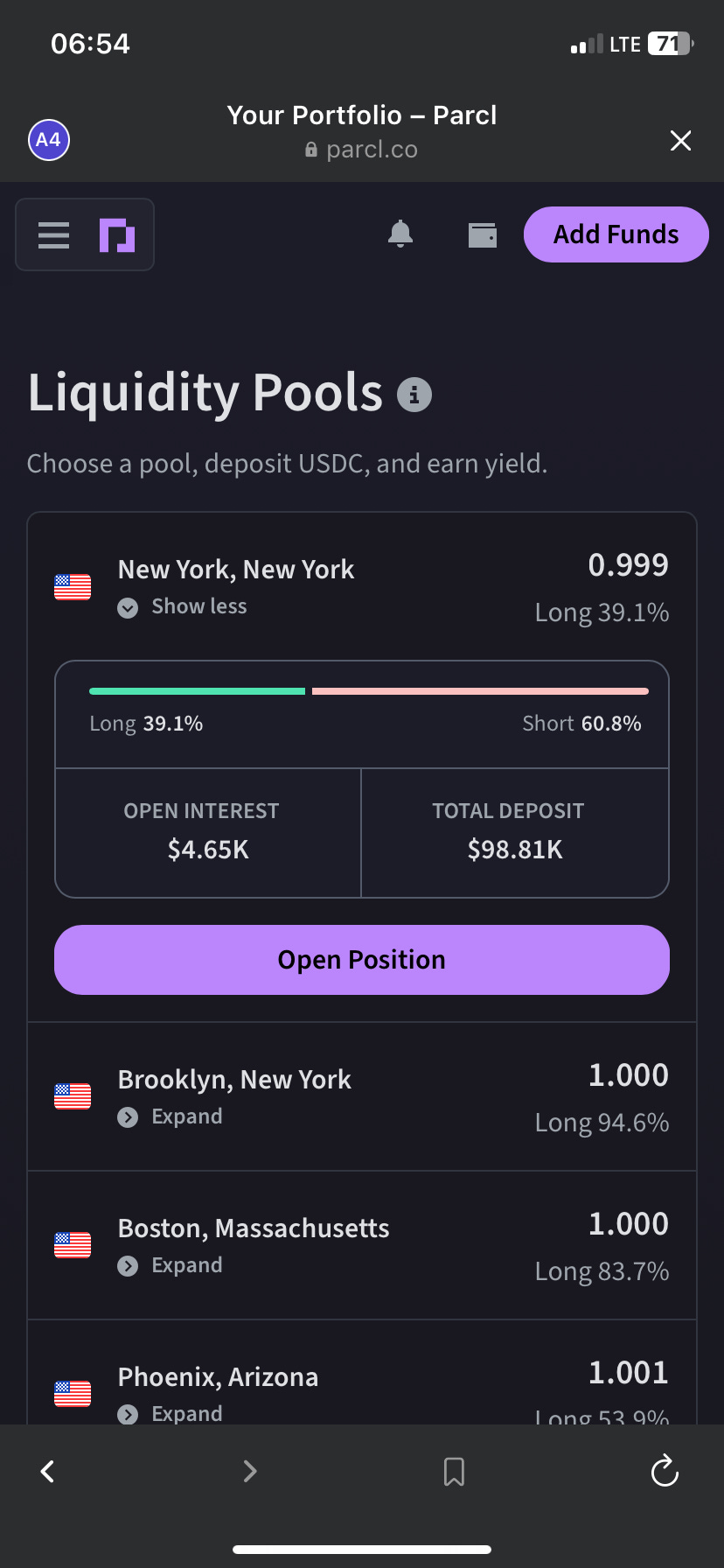
Price which indicates price of the index based on the median price per city square foot
Trade
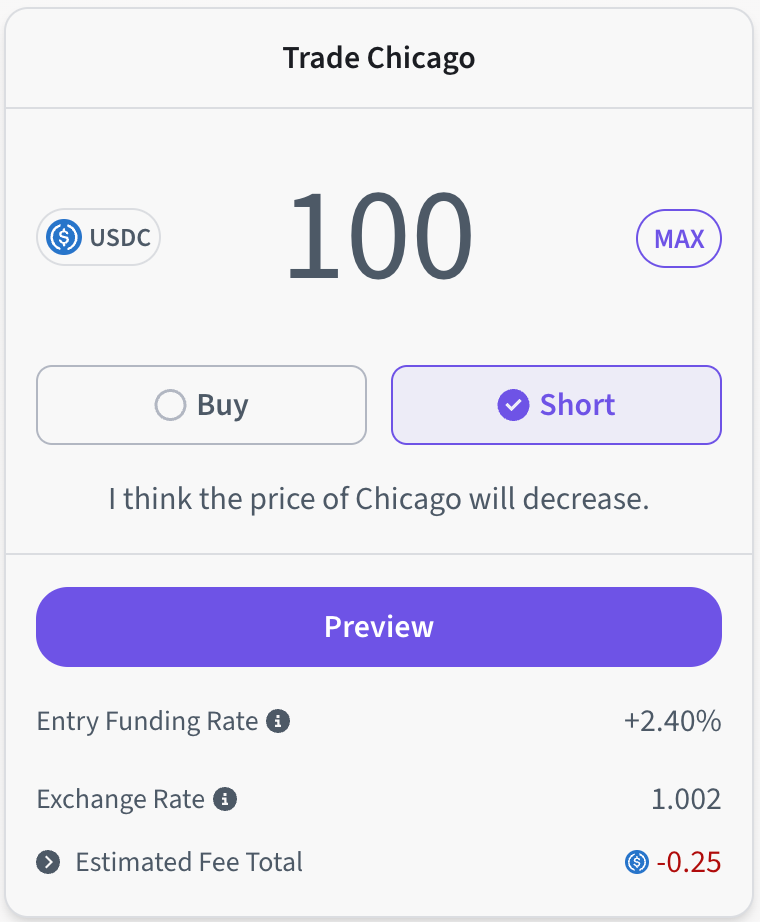
After your analysis you can decide whether too long or short a stock a stock.
Liquidity provision
You can also provide liquidity if you don’t want to trade. Liquidity providers deposit their USDC worth of liquidity in the pool and earn returns whenever a trade is made in that pool.
Simply go to the provide liquidity tab and select the pool you want provide liquidity for
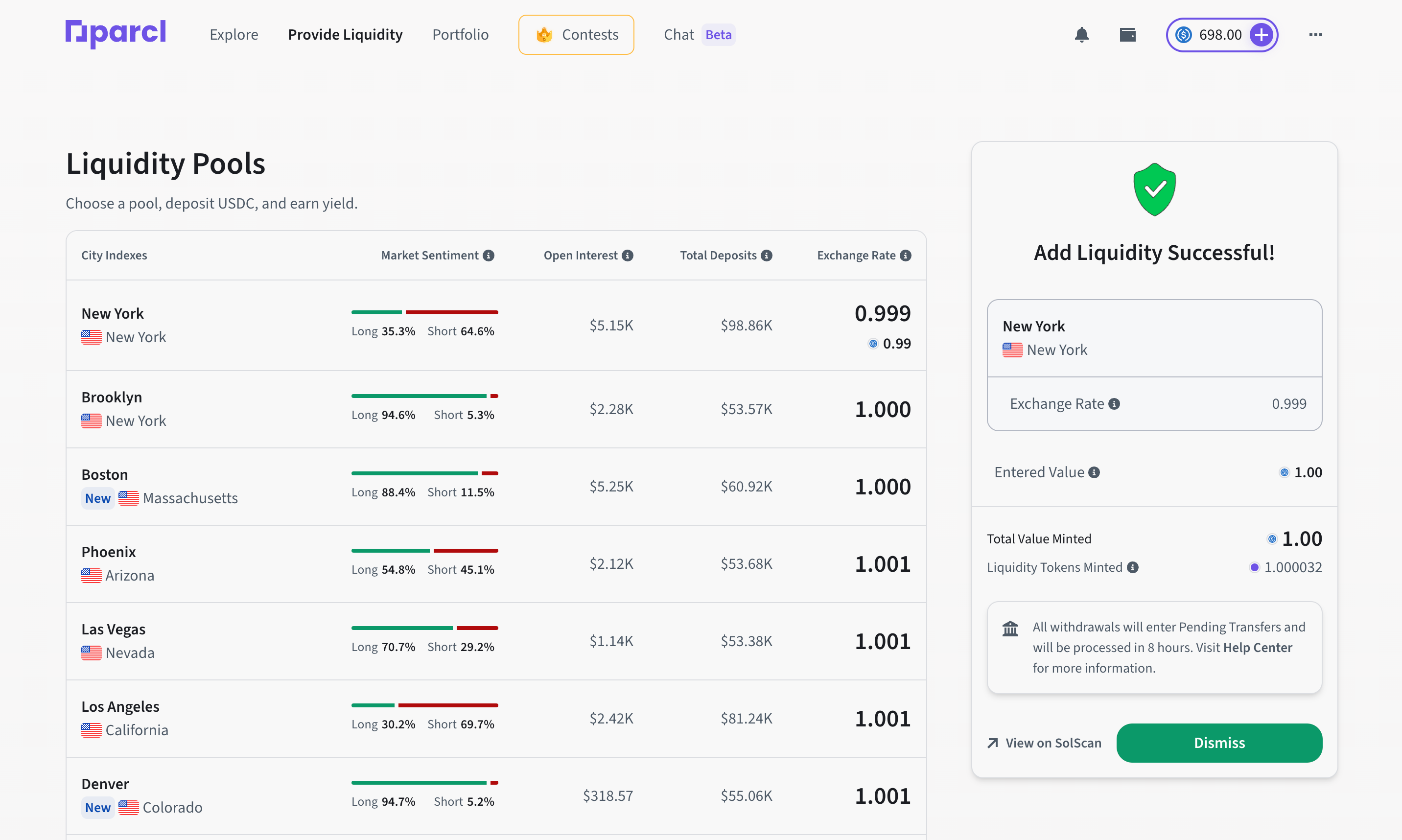
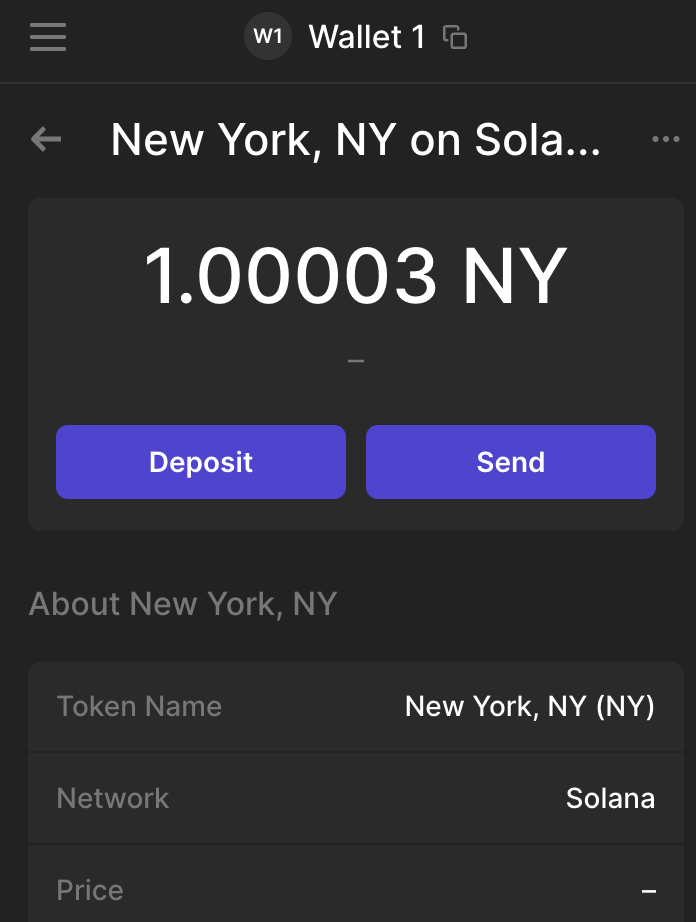
You will get corresponding tokens that you can sell for usdc at anytime
Conclusion
Parcl presents an unprecedented level of access into real estate by reducing the financial barriers and the regulatory process required to acquire properties, they are capturing an audience who prior was uninterested with the hassles that came with owning real estate.
We had fun researching this project and ended up buying assets simply because of how easy it was. Shout out to superteam for the inspiration to write this piece.
 | A guest post by
|